01: Overview
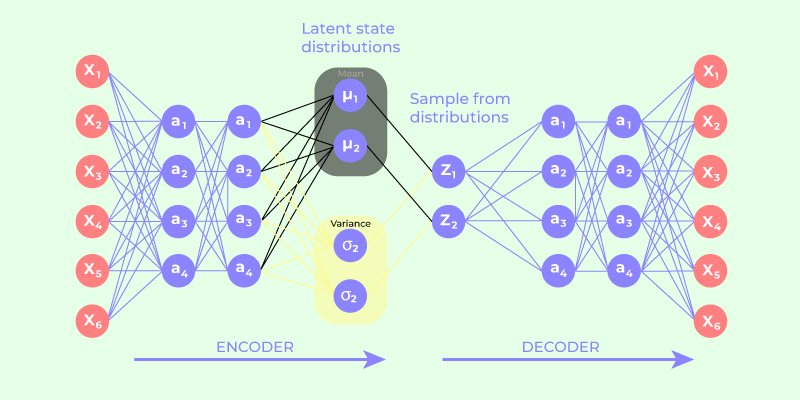


VAEs are the Rosetta Stone between “classical” latent-variable models and the modern generative zoo—diffusion, EBMs, JEPA, world models all inherit pieces of this logic, even when they loudly deny it.
Let’s walk this in a systematic, model-builder’s way, using the screenshot as our concrete anchor rather than a fog of abstractions.
1. What problem a VAE is actually solving
At heart, a VAE is doing approximate Bayesian inference in a latent-variable model.
We posit a generative story:
- Sample a latent variable \(z \sim p(z)\), usually \(\mathcal{N}(0, I)\)
- Generate data \(x \sim p_\theta(x \mid z)\)
This defines a joint distribution:
What we want is the marginal likelihood:
That integral is the villain of the story. Deep nets make it intractable.
2. Variational inference: replacing the impossible with the trainable
Enter the encoder—not as a compression device, but as an approximate posterior:
Instead of solving Bayes’ rule exactly, we learn a distribution that’s close.
This gives us the ELBO (Evidence Lower Bound):
This equation is the soul of the VAE. Everything in your screenshot is just bookkeeping around this identity.
3. Why the encoder outputs μ and σ, not a point
A deterministic autoencoder learns:
A VAE learns:
The encoder does not compress \(x\) to a single point in latent space. Instead it reads \(x\) and outputs two vectors — a mean \(\mu(x)\) and a spread \(\sigma(x)\) — that together describe a bell-shaped region where the latent code for this input probably lives.
Usually this region is modeled as an axis-aligned Gaussian:
Each dimension of the latent space gets its own independent Gaussian, centred at \(\mu_i(x)\) with standard deviation \(\sigma_i(x)\). The
diagjust means the dimensions are treated as independent — no off-diagonal correlations. So the encoder's job is really: "given this input, where in latent space should I look, and how uncertain am I about each direction?"
This matters because:
- We are learning a distribution over latent causes, not a code
- The KL term forces this distribution to stay near the prior
- Sampling becomes meaningful: different \(z\)'s produce different but plausible \(x\)'s
Your screenshot’s green (\(\mu\)) and purple (\(\sigma\)) blocks are not decoration—they are the model.
4. The reparameterization trick: making randomness differentiable
Sampling is not differentiable:
So we rewrite it as:
Now:
- Randomness is isolated in \(\epsilon\)
- \(\mu\) and \(\sigma\) are deterministic functions of \(x\)
- Gradients flow cleanly through the graph
This is why the trick is not a hack—it’s a change of variables.
In your screenshot, the blue ε block feeding into \(\mu + \epsilon \odot \sigma\) is the mathematical pivot that makes VAEs trainable.
5. Why the KL term has that closed form
Because both distributions are Gaussians:
The KL divergence reduces to:
This term:
- Penalizes large means (keeps latent centered)
- Penalizes tiny variances (prevents memorization)
- Encourages smooth, well-filled latent space
This is why VAEs interpolate nicely but look blurry: you’re paying for continuity with entropy.
6. Decoder: likelihood, not reconstruction “error”
One subtle but crucial point:
The decoder defines a likelihood model, not just a pixel predictor.
Examples:
- Bernoulli → binary images
- Gaussian → continuous data
- Categorical → tokens
So the reconstruction term is:
Mean squared error is just one special case of a Gaussian likelihood with fixed variance.
7. Conditional VAE (cVAE): controlled generation
Now we add a condition \(y\):
Generative story:
Inference:
ELBO:
Practically:
- Concatenate \(y\) to encoder input
- Concatenate \(y\) to decoder input
- Sampling with fixed \(y\) gives conditional generation
This is the conceptual ancestor of classifier-free guidance in diffusion.
8. Mental model: what VAEs get right—and wrong
VAEs give you:
- Explicit latent variables
- Amortized inference
- A proper probabilistic objective
- A bridge between Bayesian models and deep nets
They struggle with:
- Sharp details (entropy pressure)
- Expressive posteriors (Gaussian bottleneck)
- Multi-modal likelihoods
Which is why the field evolved toward:
- Diffusion (score matching instead of likelihood)
- EBMs / JEPA (implicit densities, no decoder likelihood)
- World models (latent dynamics + control)
9. How this connects forward to your roadmap
You can think of modern generative models as VAEs that rebelled:
- Diffusion: remove decoder likelihood, learn score instead
- EBMs / JEPA: drop explicit density, learn energy or invariants
- World models: put dynamics inside the latent space
- Flow matching: continuous reparameterization without KL
But the core tension—latent structure vs tractability—starts here.
Suggested next step (logical, not trendy)
Before jumping to diffusion, a powerful intermediate stop is:
- β-VAE (disentanglement vs capacity)
- IWAE (tightening the ELBO)
- VAE with learned priors (VampPrior)
Those sharpen your intuition for why diffusion took over—and what it sacrificed.
When you’re ready, we can deliberately “break” the VAE and watch diffusion emerge from the wreckage.
10. References & Further Reading
Foundational Papers
- Kingma & Welling (2014) — "Auto-Encoding Variational Bayes" — The original VAE paper
- Rezende et al. (2014) — "Stochastic Backpropagation and Approximate Inference in Deep Generative Models"
- Sohn et al. (2015) — "Learning Structured Output Representation using Deep Conditional Generative Models" — cVAE
VAE Variants
- Higgins et al. (2017) — "β-VAE: Learning Basic Visual Concepts with a Constrained Variational Framework"
- Burda et al. (2016) — "Importance Weighted Autoencoders" (IWAE)
- Tomczak & Welling (2018) — "VAE with a VampPrior"
Bridge to Diffusion
- Cao et al., "A Survey on Generative Diffusion Models" (2024) — Comprehensive treatment of score matching and diffusion
- Song & Ermon (2019) — "Generative Modeling by Estimating Gradients of the Data Distribution"
- Ho et al. (2020) — "Denoising Diffusion Probabilistic Models" (DDPM)
Biology Applications
- Lopez et al. (2018) — "Deep generative modeling for single-cell transcriptomics" (scVI)
- Lotfollahi et al. (2019) — "scGen: Predicting single-cell perturbation responses"
Learning Roadmap
See ROADMAP.md for the full progression from VAE → Diffusion → EBMs → JEPA → World Models.